
Pest control service reports are the proof that a site is being looked after. For a food business, they’re often the first thing an environmental health officer or an auditor asks to see. For a landlord or a facilities manager, they show what was found and what was done. This guide covers what pest control service reports should record on every visit, how to keep bait box logs straight, and how to make the reports useful to the customer.
Why the records matter
Food businesses have a legal duty to keep pests under control, and inspectors and auditors judge that partly on the records. Pest control service reports that are vague or missing details make the customer look careless, even if the work was good.
Pest control service reports also protect your own business. If a customer has an infestation between visits, a clear record shows what you found, what you used, and what you told them to do.
What pest control service reports should include
The visit
- The customer’s name and the site address.
- The date and time of the visit, and the technician’s name.
- The type of visit: routine inspection, follow-up, call-out or treatment.
- Who you spoke to on site, and who signed.
What you inspected
- The areas inspected, by name: kitchen, dry store, bin store, loading bay.
- Any areas you couldn’t get to, and why.
- Each monitoring and bait point checked, by its number.
What you found
- Any signs of activity: droppings, gnawing, sightings, damage to stock or packaging.
- Which pest, and where, as precisely as you can.
- Photos of the evidence, marked up where it helps.
- Proofing problems: gaps under doors, holes around pipes, damaged air bricks.
- Housekeeping problems that encourage pests: food left out, waste build-up, spillages.
What you did
- Any treatment carried out, and where.
- Each product used: its name, the amount and where it was placed.
- Any traps set, moved or removed.
- Any proofing work done on the day.
What the customer needs to do
- Recommendations, in order of priority, with a timescale.
- Anything that needs a quote, such as major proofing.
- When the next visit is due.
Bait box logs
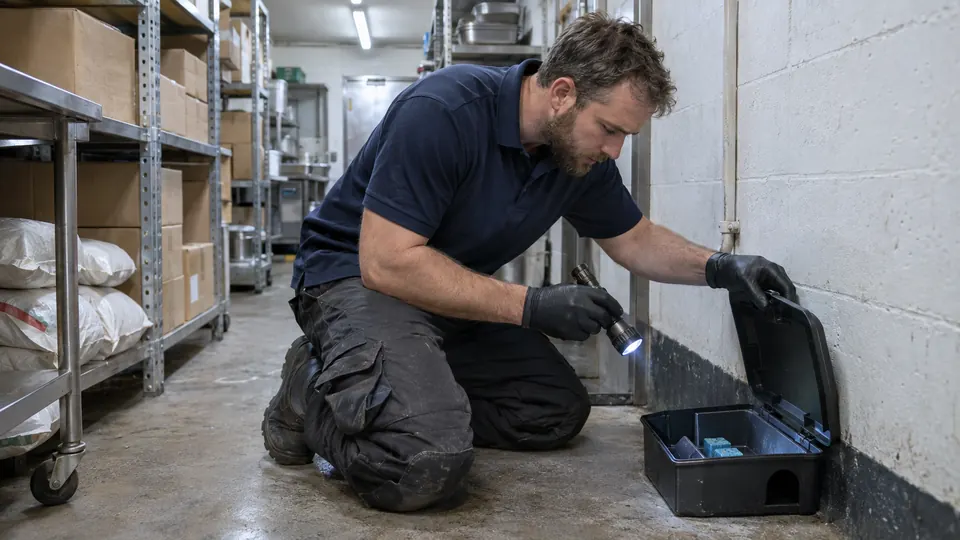
On sites with many monitoring or bait points, a log of each point is as important as the report itself. Number every point, and keep a site plan showing where each one is. At each visit, record for every point:
- whether it was checked;
- whether there was any activity;
- what’s in it, and whether it was topped up or replaced;
- any damage, or if the point is missing.
A missing or damaged box is worth reporting straight away. If it was moved by the customer’s staff, the plan needs updating, or the next technician won’t find it.
Keep the log with the site, so whoever visits next can see the history of each point. Over time, it shows where activity keeps coming back, and that’s where proofing work is worth quoting.
Chemicals and COSHH
Pest control products are hazardous substances, and the Control of Substances Hazardous to Health Regulations 2002 (COSHH) require you to assess and control the risks from them. Follow the product label, keep the safety data sheets and COSHH assessments with the job, and record exactly what was used and where. Customers with food on site will want to know that products were placed where they can’t contaminate it.
Making pest control service reports useful to the customer
Pest control service reports full of codes don’t help a restaurant manager. Write the findings and recommendations in plain words, and put the most urgent thing first. Send the report the same day, to the person who needs to act on it.
For customers with several sites, keep each site’s reports and logs separate, under the one customer. A facilities manager preparing for an audit at one site wants that site’s history, not everything you’ve ever done for them.
Cleaning businesses build the same kind of evidence on every job; see the end of tenancy cleaning checklist for how they lay out a photo report. Grounds maintenance crews plan repeat visits by season in much the same way as routine pest control; see how to plan a grounds maintenance schedule.
For the official guidance, see using biocides safely (opens in a new tab) on the HSE website.
Pest control service reports in JobHandler
When JobHandler opens, the office can attach pest control service reports and bait box logs to each job, and your technicians fill them in on their phone with photos, marked up and stamped with your business name, date and time. Consumables levels in your store show when bait stock is running low. See more on JobHandler for cleaning and pest control businesses.
This is general guidance. Pest control work and its records are your business’s responsibility, so check the current rules before you rely on it.
Join the waiting list and we’ll email you when JobHandler opens.